有没有关于美国西部的诗
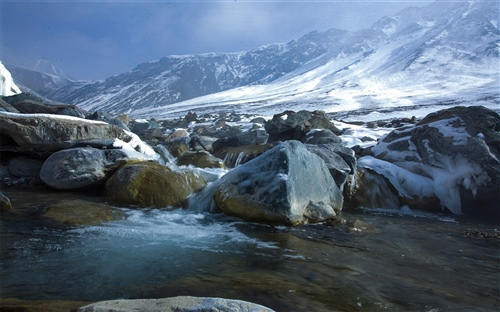
China ranges from mostly plateaus and mountains in the west to lower lands in the east. Principal rivers flow from west to east, including the Yangtze (central), the Huang He (Yellow river, north-central), and the Amur (northeast), and sometimes toward the south (including the Pearl River, Mekong River, and Brahmaputra), with most Chinese rivers emptying into the Pacific Ocean.In the east, along the shores of the Yellow Sea and the East China Sea there are extensive and densely populated alluvial plains. On the edges of the Inner Mongolian plateau in the north, grasslands can be seen. Southern China is dominated by hills and low mountain ranges. In the central-east are the deltas of China's two major rivers, the Huang He and Yangtze River. Most of China's arable lands lie along these rivers, and they were the centers of China's major ancient civilizations. Other major rivers include the Pearl River, Mekong, Brahmaputra and Amur. Yunnan Province is considered a part of the Greater Mekong Subregion, which also includes Myanmar, Laos, Thailand, Cambodia, and Vietnam.Main geographic features and regions of China.In the west, the north has a great alluvial plain, and the south has a vast calcareous tableland traversed by hill ranges of moderate elevation, and the Himalayas, containing Earth's highest point, Mount Everest. The northwest also has high plateaus with more arid desert landscapes such as the Takla-Makan and the Gobi Desert, which has been expanding. During many dynasties, the southwestern border of China has been the high mountains and deep valleys of Yunnan, which separate modern China from Burma, Laos and Vietnam.The Paleozoic formations of China, excepting only the upper part of the Carboniferous system, are marine, while the Mesozoic and Tertiary deposits are estuarine and freshwater, or else of terrestrial origin. Groups of volcanic cones occur in the Great Plain of north China. In the Liaodong and Shandong Peninsulas, there are basaltic plateaus.The climate of China varies greatly. The northern zone (containing Beijing) has summer daytime temperatures of more than 30 degrees Celsius and winters of Arctic severity. The central zone (containing Shanghai) has a temperate continental climate with very hot summers and cold winters. The southern zone (containing Guangzhou) has a subtropical climate with very hot summers and mild winters.Due to a prolonged drought and poor agricultural practices, dust storms have become usual in the spring in China. Dust has blown to southern Mainland China and Taiwan, and has reached the West Coast of the United States. Water, erosion, and pollution control have become important issues in China's relations with other countries.
这是美国很火的小诗有什么含义,还有它是谁写的呀
'
是你的终究是你的,到了那个时候你就会得到属于你的成就,不必与同年龄段人比较。
这是勉励别人永不放弃拼搏精神的一首小诗,即使青年、中年时仍未有成就,老年了继续拼搏仍然有成就的可能比如特朗普。
谁写的不知道。
求一首英国或美国的诗
A Grain of SandTo see a world in a grain of sand, And a heaven in a wild flower, Hold infinity in the palm of your hand, And eternity in an hour.一粒沙子从一颗沙里看到整个世界,一朵野花就是一座天堂,把无限放在你的手掌上,永恒就在那一瞬间。
英国第一位重要的浪漫主义诗人威廉·布莱克( WilliamBlake,1757 —1827 )威廉·布莱克活着的时候没人知道,直到20世纪初才被挖掘出来。
这几行诗在欧美并不是那么有名,讲起布莱克的时候,也不把这看作他的代表作。
似乎只有中国人才特别迷恋这几句话,我猜想也许因为这首诗跟佛教思想有相通之处有关系。
这四行诗选自一首长达132行、名为《天真的预兆》(Auguries of Innocence)的长诗,是开头四行。